Stormwater Forebay Maintenance and Restoration
Forebays are one of the most important and often overlooked components of a stormwater management system. Positioned at key inflow points, their role is straightforward: capture sediment and debris before it enters the main pond or basin. When functioning properly, forebays reduce maintenance demands, protect water quality, and extend the lifespan of downstream BMP components.
When forebays are neglected, however, the impact is not isolated. As sediment accumulates and storage capacity is reduced, performance declines across the entire system. Issues that originate at the forebay begin to cascade downstream, affecting pond depth, water clarity, vegetation balance, and structural performance.
At Ecological Improvements, forebay maintenance and restoration are approached as system-critical interventions. Rather than treating sediment accumulation as a localized issue, we evaluate how forebay performance influences the broader BMP network. This page provides a comprehensive, technical guide to stormwater forebays, explaining how they function, how they fail, and how structured restoration and maintenance strategies preserve long-term system performance.
What a Stormwater Forebay Is and Why It Matters
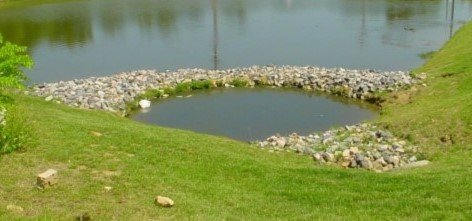
A stormwater forebay is a designated pretreatment zone located at or near the inlet of a pond, basin, or wetland BMP. Its purpose is to intercept sediment, debris, and coarse pollutants before they disperse throughout the main treatment area.
From a hydraulic perspective, forebays reduce inflow velocity. As runoff enters the forebay, flow energy is dissipated, allowing suspended particles to settle. This process prevents fine sediments from being transported deeper into the pond where removal becomes more complex and costly.
From a maintenance standpoint, forebays are designed as sacrificial zones. They are intended to accumulate sediment over time and be cleaned out periodically. By concentrating sediment in a defined area, forebays simplify maintenance and reduce the frequency of large-scale dredging operations.
From a water quality perspective, forebays protect downstream treatment zones. By removing sediment early, they reduce turbidity, nutrient loading, and organic accumulation in the main basin.
When forebays function as intended, they operate quietly and efficiently. When they are neglected, they become one of the primary drivers of system decline.
How Forebays Fail Over Time
Forebay failure is rarely abrupt. It develops gradually as sediment accumulates and hydraulic conditions change.
The most common issue is loss of storage volume. As sediment builds up, the effective depth of the forebay decreases. Eventually, the forebay reaches a point where incoming flows can no longer slow sufficiently to allow sediment to settle.
When this threshold is reached, flow begins to short-circuit across the surface. Instead of dropping out within the forebay, sediment is transported directly into the main pond.

This shift has several downstream consequences:
Sediment deposits in the main basin, reducing overall storage capacity.
Water becomes shallower, increasing temperature and promoting algae growth.
Aquatic vegetation and nuisance weeds establish more easily in reduced depths.
Treatment efficiency declines as detention time decreases.
Debris accumulation further complicates performance. Organic material and trash can clog inlet structures and obstruct flow paths. This increases localized velocities and may contribute to erosion at entry points.
Root systems from unmanaged vegetation introduce additional challenges. Woody growth within forebays anchors sediment, making excavation more difficult. As roots decay, they create voids that destabilize soils and alter flow patterns.
Forebay failure is therefore not just a sediment issue. It is a shift in how the system processes water, sediment, and energy.
The System-Wide Impact of a Neglected Forebay
A neglected forebay affects every downstream component of a stormwater BMP.
As sediment bypasses the forebay, the main pond begins to fill. This reduces effective storage volume and compromises design performance. Detention time decreases, limiting pollutant settling and increasing discharge rates.
Water quality declines as nutrient-rich sediments accumulate. Algae blooms become more frequent, and water clarity diminishes. These conditions can lead to regulatory concerns and negative perceptions from residents or stakeholders.
Structural components are also affected. Increased sediment loads can bury outlet structures, restrict flow, and alter water levels. In extreme cases, clogged systems may contribute to localized flooding.
Maintenance costs escalate as well. Instead of performing routine forebay cleanouts, property owners are faced with large-scale dredging projects that impact the entire pond.
These cascading effects highlight the importance of maintaining forebays as the first line of defense.
Early Warning Signs of Forebay Underperformance
Identifying forebay issues early allows for targeted intervention before system-wide impacts occur.
Common warning signs include:
Visible sediment deltas at inlet points expanding into the main basin.
Reduced water depth within the forebay compared to design conditions.
Water flowing across the surface without visible settling.
Accumulation of debris or organic material at inlets.
Encroachment of woody vegetation within the forebay footprint.
Increased turbidity or sediment deposition in the main pond.
Routine inspections should include sediment depth measurements and visual assessment of flow patterns. These observations provide early indicators of declining performance.
Ecological Improvements’ Structured Forebay Restoration Process
Forebay restoration requires more than sediment removal. It must restore hydraulic function, structural stability, and long-term maintainability.
Assessment and Mapping
The process begins with a detailed evaluation of existing conditions. This includes measuring sediment depth, identifying root structures, assessing access constraints, and understanding how the forebay interacts with the main basin.
Mapping the forebay footprint and documenting flow paths provides the foundation for restoration planning.
Targeted Excavation
Sediment removal is performed using methods and equipment selected for site conditions. The goal is to remove accumulated material while minimizing disturbance to adjacent banks, structures, and vegetation.
Careful excavation prevents unintended damage and preserves surrounding stability.
Regrading and Shaping
After excavation, the forebay is reshaped to restore proper depth and geometry. This ensures that incoming flows are slowed effectively and sediment settles where intended.
Transitions between the forebay and main basin are refined to prevent short-circuiting.
Vegetation and Stabilization
Disturbed areas are stabilized using erosion control materials and, where appropriate, native plantings. Vegetation is selected to complement hydraulic function without obstructing flow or access.
Proper stabilization prevents rapid re-erosion and supports long-term performance.
Maintenance Planning
Restoration is not complete without a forward-looking maintenance strategy. Inspection intervals, sediment thresholds, and cleanout schedules are established based on site conditions.
This planning ensures that the forebay continues to function as designed.
Sediment Management Strategies for Long-Term Performance
Sediment management is central to forebay function. Effective strategies include:
Monitoring sediment accumulation regularly.
Performing cleanouts before capacity is exceeded.
Addressing upstream erosion sources to reduce loading.
Maintaining inlet stabilization to prevent localized scour.
By managing sediment proactively, forebays remain effective and reduce pressure on downstream BMP components.
Vegetation Management Within Forebays
Vegetation within forebays must be managed carefully. While some plant presence can support stabilization, unmanaged woody growth introduces risks.
Selective vegetation management ensures that:
Flow paths remain clear.
Root systems do not obstruct excavation.
Soil stability is maintained without creating structural weaknesses.
Balancing vegetation and hydraulic function is essential for long-term success.
Cost Implications of Proactive Versus Reactive Maintenance
Proactive forebay maintenance is significantly more cost-effective than reactive restoration.
Routine cleanouts involve limited excavation and minimal disruption. In contrast, deferred maintenance often leads to full pond dredging, structural repairs, and extended project timelines.
From a budgeting perspective, predictable maintenance costs are easier to plan and manage than large, unexpected capital expenditures.
Regulatory and Compliance Considerations
Forebays play a key role in maintaining BMP performance and meeting regulatory requirements.
Failure to manage sediment and maintain design capacity can result in non-compliance with stormwater permits. Inspections may identify reduced treatment efficiency, structural issues, or maintenance deficiencies.
Documented maintenance activities demonstrate due diligence and support compliance efforts.
Integrating Forebay Maintenance Into BMP Lifecycle Planning
Forebay maintenance should be integrated into overall BMP lifecycle planning. This includes:
Establishing baseline conditions after construction.
Scheduling routine inspections.
Defining sediment removal thresholds.
Coordinating maintenance with broader BMP management strategies.
A lifecycle approach ensures that forebays continue to function effectively as part of the larger system.
Ecological Improvements’ Approach to Forebay Management
Ecological Improvements treats forebays as critical infrastructure components. Our approach combines field assessment, targeted restoration, and long-term maintenance planning.
By focusing on function rather than appearance, we help clients maintain predictable, efficient systems that reduce risk and extend asset lifespan.
Contact Us!
If your stormwater forebay is showing signs of sediment buildup, reduced depth, or declining performance, a targeted restoration and maintenance plan can prevent larger system issues. Ecological Improvements provides structured forebay assessments, excavation, and long-term management strategies that protect the health of your entire BMP system. Contact our team to evaluate your forebay and develop a plan that keeps it functioning effectively.