How to Improve Stormwater Management on an Existing Property
Low Impact Development, or LID, is often discussed during the design of a new property. Existing properties present a different challenge. Buildings, pavement, drainage pipes, landscaping, and property boundaries are already in place, so the question becomes where runoff can be managed more effectively without disrupting how the site is used.
An LID retrofit introduces or modifies stormwater practices within that established layout. It might redirect runoff from a roof into a planted treatment area, replace part of a parking surface with permeable pavement, improve a drainage swale, or add treatment before water enters an existing pond. The appropriate choice depends on the runoff source, available space, soils, groundwater, utilities, and maintenance capacity.
The goal is not to install as many green features as possible. It is to solve a defined drainage or water quality problem with practices that fit the property and can be maintained over time. This guide explains how to identify retrofit opportunities, test their feasibility, select practices, and measure whether they are working.

Find the Retrofit Opportunity Before Choosing a Practice
The most useful starting question is not “Where can we put a rain garden?” It is “Where does runoff come from, where does it go, and what problem are we trying to address?” A practice selected for appearance or available space alone may receive too little water to matter, too much water to function as intended, or runoff carrying sediment that quickly overwhelms it.
Begin by mapping the contributing drainage areas. Identify roofs, parking lots, roads, walkways, landscaped areas, and any off-site areas that drain through the property. Then trace the pathways between them: downspouts, curb openings, catch basins, pipes, swales, low points, ponds, and outfalls. Existing plans can help, but field observations are important where drainage has changed since construction.
Watch the site during or shortly after rain when it is safe to do so. Note where water concentrates, where it bypasses an inlet, where sediment settles, and which areas remain wet. Compare those observations with complaints, maintenance records, and prior inspection photographs. A single wet area may reflect a blocked inlet, compacted soil, an unintended low spot, or a downstream restriction. Each calls for a different response.
Define the problem in terms of runoff
A retrofit can pursue several goals: reducing runoff volume from a defined surface, slowing the rate at which water reaches an existing system, filtering runoff before it enters a pond, stabilizing an eroding flow path, or reducing the sediment that reaches a downstream practice. Naming the goal makes proposed options easier to evaluate.
For example, a parking lot that sends sediment-laden water directly into a pond presents a different opportunity from a roof that discharges clean runoff onto compacted turf. The first may benefit from attention to sediment sources and pretreatment before a planted practice. The second may offer an opportunity to disconnect a downspout, provided the receiving area has suitable soils, safe overflow, and adequate separation from buildings.
The location of the problem does not always reveal its cause. Repeated pond sediment removal may indicate erosion upstream. A swale that fails to support vegetation may be receiving concentrated flows beyond what its current shape can handle. A flooded parking space may result from an obstructed downstream structure rather than a lack of permeable pavement. Diagnose the connected system before committing to a new installation.
Look for opportunities during planned site work
Retrofits can be easier to incorporate when a property is already replacing pavement, renovating landscaping, repairing utilities, or restoring a stormwater feature. These projects may create access to areas that would otherwise be costly to disturb. Coordinating the work also allows the design team to consider how the proposed LID practice connects to existing grades and drainage infrastructure.
That does not mean every renovation should include an infiltration practice. The opportunity is to evaluate whether runoff management can be improved while the area is open. A narrow planting strip, for instance, might be suitable for a specifically designed treatment feature, or it might be needed for utilities and maintenance access.
For established communities, inventory gaps can affect these decisions. Before redirecting water, confirm where existing pipes lead and who maintains the receiving structures. Our article on understanding the stormwater system you ownwould be a natural internal link here. It addresses the system knowledge needed before changing a drainage route.
A successful opportunity assessment ends with a short list of locations, the runoff each could receive, the problem each could address, and the questions that still need investigation. That is more useful than selecting a practice from a standard list and trying to make the site accommodate it.
Test Whether the Site Can Support the Proposed Retrofit
A promising location on a map may be unsuitable once conditions below the surface are examined. Soil infiltration, groundwater elevation, buried utilities, previous land use, and nearby structures all affect what can be built safely and how it will perform. EPA advises evaluating site conditions and working with design professionals who understand local requirements and the specific practice being considered. US EPA
Soil is a central consideration for infiltration-based retrofits. A lawn can appear absorbent while its underlying soil is compacted by years of equipment traffic or construction. Conversely, surface puddling may have a localized cause that does not represent conditions throughout the site. An appropriate field investigation helps the designer evaluate infiltration capacity where the practice would actually be installed.
Low infiltration rates do not rule out every LID option. A bioretention practice may be designed to filter water through engineered media and discharge through an underdrain, subject to site requirements and a suitable outlet. Other approaches, such as rainwater harvesting or certain vegetated conveyance practices, do not depend on water soaking into native soil. The design should reflect the measured conditions rather than assume infiltration will occur. US EPA
Check groundwater and prior land use
Infiltrating runoff into the ground requires attention to groundwater depth and quality. A high water table may limit the space available below a practice, while contaminated soil or runoff from a potential pollution source can create groundwater concerns. Prior commercial or industrial uses warrant investigation before infiltration is proposed.
EPA recommends considering soil infiltration rates, depth to groundwater, prior property use, potential pollutants, nearby wells, and other site factors. Where infiltration could introduce pollutants into groundwater, filtration, evapotranspiration, an underdrain, or an impermeable liner may be more appropriate, depending on the design and applicable requirements. These decisions call for site-specific professional evaluation. US EPA
This is particularly relevant on properties with vehicle maintenance, material storage, fueling, or other activities that may affect runoff quality. A planted feature is not automatically an appropriate destination for every flow. Understanding what enters the practice is part of determining how it should be designed and maintained.
Account for what is already built
A retrofit must fit around foundations, buried utilities, accessible routes, parking operations, fire access, mature trees, and existing drainage structures. The design team should also identify where water will go when the practice is full or a storm exceeds the volume it was designed to manage. An overflow route that sends water toward a building or across a heavily used walkway can create a new problem.
Available area matters, but usable area matters more. A shallow landscaped strip may seem large enough until setbacks, utility corridors, slopes, and maintenance access are considered. EPA notes that access for maintenance equipment should be included in green infrastructure design. US EPA
For parking areas, the feasibility review should consider pavement condition, traffic and loading needs, sediment sources, and the ability to maintain the proposed surface. For rooftop practices, structural capacity and access require professional review. For planted systems, available sunlight, wetness, soil conditions, and the way the surrounding property is maintained affect plant selection.
Confirm the approval pathway
Retrofitting an existing site can change grading, drainage connections, impervious surfaces, or an approved stormwater facility. Before work begins, determine whether plans, permits, easement review, or approval from the relevant local authority are required. Requirements vary by location and project scope, so a general LID concept should not be treated as an approved construction plan.
The feasibility stage should narrow the options and expose constraints early. It may show that a location suited to surface filtration is poorly suited to infiltration, or that a proposed practice would be difficult to maintain without changing the layout. Finding that out before construction is part of good design, not a failed project.
Match the Practice to the Runoff and the Property
LID is an approach to managing runoff near its source, not a single product or construction detail. Practices can infiltrate, filter, store, reuse, or slow water, and many combine several of those functions. An existing property may benefit from one targeted retrofit or several smaller changes distributed across the site.
Selection should follow the findings from the drainage assessment and feasibility work. Consider the contributing drainage area, runoff quality, space, slope, soils, groundwater, available outlet, and maintenance resources. Then ask what each proposed practice will do during ordinary rainfall and how excess water will move safely through the larger system.
Roof runoff: evaluate disconnection and storage
Roofs often provide a clearly defined runoff source. Where conditions allow, a downspout may be directed to a suitable landscaped area, a designed bioretention practice, or a storage system used for an appropriate purpose. The receiving area must be assessed for its ability to manage the flow without saturating ground near foundations or sending water onto neighboring property.
Rainwater harvesting can capture some roof runoff for later use, but the benefit depends on available storage and a realistic demand for the water. If storage remains full, the next rainfall will bypass it through an overflow. The overflow therefore needs a planned connection or discharge route. Maintenance includes keeping inlets, screens, storage components, and overflow pathways functional.
A roof is sometimes one of the simplest drainage areas to isolate, but a simple source does not guarantee a simple retrofit. Downspout locations, building details, space at ground level, and local requirements still control what is feasible.
Parking lots and roads: address sediment before it reaches treatment
Large paved areas can generate substantial runoff from a relatively small footprint. They also collect sediment and other pollutants that can interfere with downstream practices. Depending on the site, options may include a properly designed bioretention area, vegetated conveyance, a stormwater planter, or permeable pavement in an appropriate location.
The edge of a parking lot may offer space to intercept runoff through a curb opening, but the feature needs the correct grades to receive water. It also needs a way to manage sediment at the inlet and an overflow route that preserves site access. A planted area placed beside pavement will provide limited stormwater value if most water flows past it into a catch basin.
Permeable pavement has different suitability and maintenance considerations from a conventional paved surface. The pavement system, underlying storage layer, subgrade, drainage design, expected vehicle use, and surrounding sediment sources all matter. If runoff carries soil onto the surface and the voids become clogged, performance can decline. EPA discusses both component care and maintenance of permeable media as part of green infrastructure operation. US EPA
Landscaped areas and swales: design for water movement
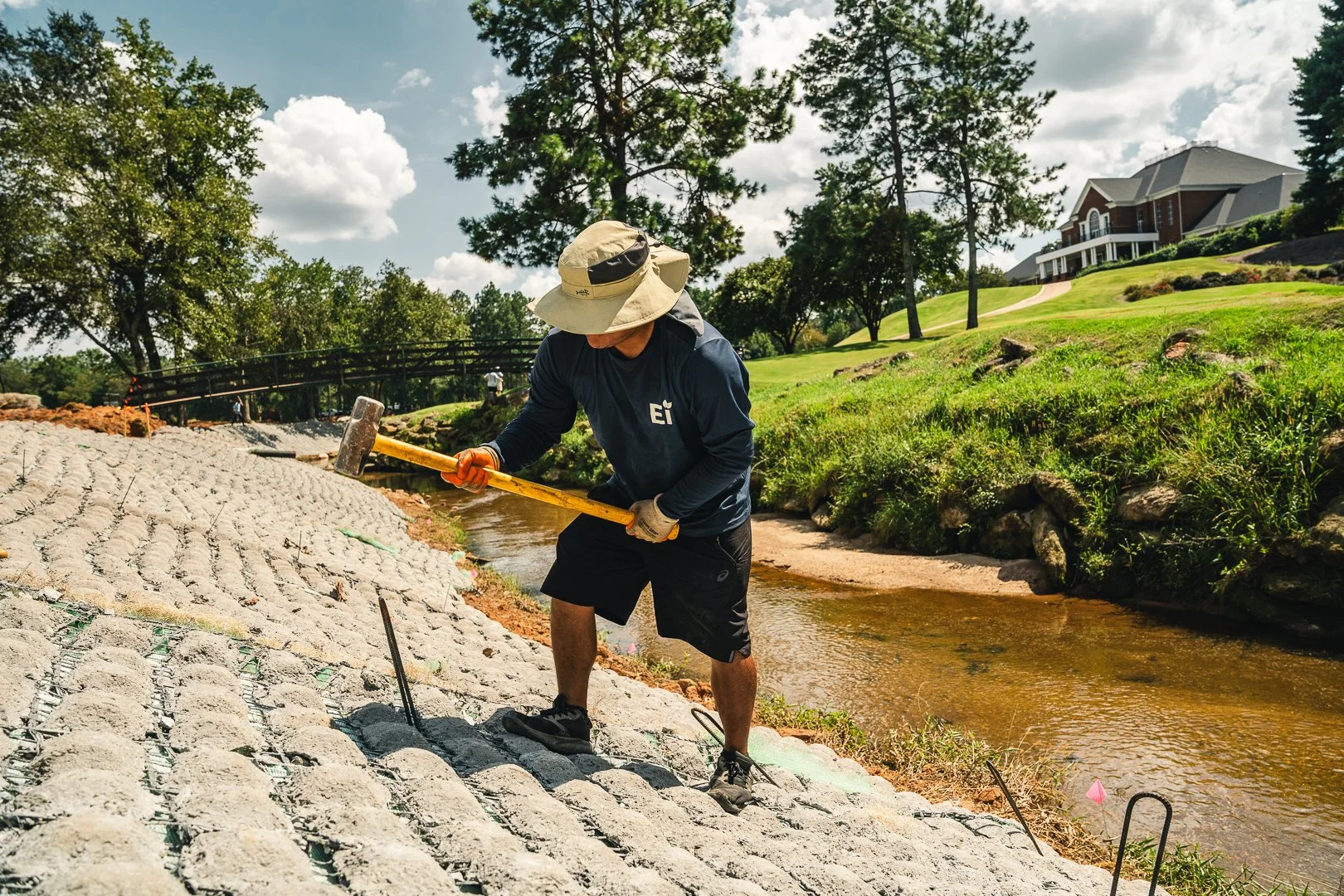
An existing swale may offer a retrofit opportunity because it already carries water, but changing its vegetation alone will not necessarily correct erosion or poor drainage. The design should examine the amount and speed of flow, slope, soil condition, and downstream outlet. Where erosion is driven by concentrated runoff, the solution may need to modify conveyance or stabilize a particular section as well as establish appropriate plants.
Bioretention areas also require more than a depression with plants. Their performance depends on the relationship between the contributing area, inlet, ponding area, soil or engineered media, underdrain where needed, overflow, and vegetation. A design that overlooks any one of these can leave the owner with persistent standing water, sediment accumulation, or plants that fail to establish.
Naturalized shorelines and vegetated buffers may help protect soil and manage runoff at a pond’s edge, but they serve a different purpose from intercepting runoff closer to its source. A property may need both. Our articles on sustainable stormwater plantings and shoreline erosion can provide deeper internal links for readers evaluating those parts of a site.
The best option may combine LID with existing pipes and ponds. Distributed treatment can reduce the burden reaching a downstream facility, while conventional structures continue to convey larger flows. A retrofit should be judged by how the entire drainage system performs after the change, not by whether a particular feature looks “green.”
Plan for Construction, Maintenance, and Measurable Results
A retrofit’s performance depends on the details that follow practice selection. Infiltration capacity can be affected by construction traffic and soil compaction. An inlet set at the wrong elevation may receive little runoff. A planted practice can struggle if sediment washes in before vegetation establishes. These are reasons to treat construction sequencing and field verification as part of the stormwater design.
Protect the area designated for a soil-based practice from unnecessary disturbance when possible. Confirm grades, drainage connections, soil or media specifications, and overflow routes during installation. Where a practice is intended to receive runoff from a defined area, verify that water can reach the inlet. The completed feature should be documented so future maintenance teams know how it is supposed to function.
Give the establishment period its own maintenance plan
New vegetation needs attention while it becomes established. Depending on the site and planting design, that may include watering, replacement of failed plants, managing invasive growth, and checking for erosion or sediment deposits. An inspection after rainfall can reveal whether water enters, spreads, and leaves the practice as expected.
Ownership of that work should be settled before installation. A landscape contractor, property maintenance crew, HOA, or municipal team may each have different responsibilities. Written instructions should distinguish ordinary landscape care from stormwater maintenance. For example, cutting all vegetation uniformly or piling mulch at an inlet could interfere with how a practice was designed to work.
EPA recommends maintenance planning, inspection records, dedicated resources, and clear communication of responsibilities for privately owned green infrastructure. The specific requirements for a property should be checked against applicable local codes, approvals, and agreements. US EPA
Check performance against the original goal
A retrofit should be evaluated against the problem it was meant to address. If the goal was to keep roof runoff away from a frequently flooded walkway, observe what happens during comparable rain events after installation. If the goal was to reduce sediment entering a pond, inspect both the retrofit and the downstream accumulation pattern over time.
Choose observations that the maintenance team can repeat. These might include photographs from fixed locations, records of debris or sediment removal, notes on how quickly a planted area drains, or recurring erosion measurements. The appropriate measures depend on the practice and project goals. Avoid claiming that a retrofit has eliminated flooding or achieved a particular pollutant reduction without evidence suited to that claim.
Results may also reveal the need to adjust upstream maintenance. A bioretention area repeatedly filled with sediment may be capturing it as intended, but the source still deserves attention. A permeable surface that receives soil from adjacent landscaping may need changes to that landscaping as well as cleaning. The retrofit becomes part of the property’s stormwater system, so its findings should inform maintenance across the system.
For a broader discussion of assigning, documenting, and verifying this work, link to our guide on building a stormwater maintenance program. That guidance applies once the new practice joins the property’s existing assets.
Choose the next step based on evidence
An existing property does not need a complete redesign to benefit from better runoff management. It does need a clear understanding of the drainage problem, a realistic assessment of site constraints, and a practice selected for a specific function. On some sites, the first step will be a targeted LID retrofit. On others, repairing an existing structure, controlling an upstream sediment source, or resolving an unknown drainage connection should come first.
Ecological Improvements can help assess existing stormwater conditions, identify practical retrofit opportunities, coordinate implementation, and plan for long-term maintenance. To discuss a property or proposed project, call 843-259-2287.