Level Spreaders: Design, Failure Modes, and Long-Term Performance
Level spreaders are one of the simplest stormwater Best Management Practices (BMP’s) in concept and one of the most frequently misunderstood in execution. Their role is narrow but critical: convert concentrated stormwater flow into shallow, uniform sheet flow that can be safely released across a stable, vegetated area. When they function correctly, level spreaders quietly protect slopes, woodlands, buffers, and downstream channels. When they fail, they accelerate erosion, create compliance exposure, and undermine the performance of the entire stormwater system upstream.
This page is written as a definitive, system-based resource on level spreaders. It explains how they are intended to function, why failures are so common, how to diagnose underperforming systems, and what it takes to rebuild them for long-term reliability. The focus is not on products, but on process, geometry, hydraulics, soils, and maintenance.
What a Level Spreader Is and What It Is Designed to Do
At its core, a level spreader is a hydraulic transition. It sits between a point of concentrated discharge and a receiving area that can safely accept sheet flow. Unlike pipes, channels, or outfalls that move water efficiently from one place to another, a level spreader deliberately reduces hydraulic energy.
The design intent is straightforward. Stormwater enters the spreader from an upstream conveyance such as a pipe, swale, or channel. The spreader then distributes that flow evenly along a horizontal lip so water exits as a thin, uniform sheet rather than a focused jet. This sheet flow spreads across a vegetated or otherwise stabilized area where velocities are low enough to prevent erosion and allow infiltration, filtration, and dissipation of energy.
From a regulatory perspective, level spreaders are often used to protect downstream waters, preserve riparian buffers, and comply with stormwater permit requirements that prohibit point discharges into sensitive areas. From a practical perspective, they are used to prevent rills, gullies, and slope failures that would otherwise develop below outfalls.
Where many systems fail is not in the concept, but in the assumption that a level spreader is a passive structure that can be installed once and ignored. In reality, it is a precision feature that depends on accurate grading, proper material selection, stable downstream conditions, and ongoing maintenance awareness. Small deviations in slope, elevation, or material behavior can cause water to reconcentrate, defeating the entire purpose of the practice.
Understanding what a level spreader is not is just as important. It is not a sediment trap. It is not a flow control device. It does not correct upstream hydraulic problems. It does not compensate for undersized pipes or excessive contributing drainage areas. When used outside its design limits, it will almost always fail.
Why Level Spreaders Fail More Often Than Expected
Despite being widely specified, level spreaders have a disproportionately high failure rate. This is not because the concept is flawed, but because execution often ignores the system context in which the spreader operates. Most failures trace back to predictable, repeatable causes that can be identified through careful site evaluation.
One of the most common failure drivers is incorrect slope and geometry. A level spreader only functions if the discharge lip is truly level along its entire length. Even small elevation differences can cause flow to favor one section of the lip. Once water concentrates at a low point, velocities increase, stone shifts, soil is exposed, and erosion initiates. Over time, the spreader transitions from a sheet flow device into an unintended channel.
Improper stone selection and placement is another frequent issue. Stone that is too small relative to design flows can be mobilized during storm events. Stone that is poorly graded or not keyed into the slope can migrate downslope, exposing subgrade soils. In many cases, installations rely on readily available stone rather than stone selected for hydraulic performance. This shortcut often goes unnoticed until a high-intensity storm reveals the weakness.
The absence or failure of underlayment is a less visible but equally destructive problem. Without nonwoven geotextile or an appropriate separation layer beneath stone, fine soils migrate upward under hydraulic pressure. As fines are lost, voids develop, stone settles unevenly, and the level lip loses its uniformity. This process is slow, which makes it difficult to diagnose until performance is already compromised.
Downstream conditions are another overlooked factor. A level spreader can be constructed correctly and still fail if the receiving area is not adequately stabilized. Sparse vegetation, compacted soils, or steep slopes below the spreader allow sheet flow to reconcentrate quickly. In these cases, erosion simply moves a short distance downslope rather than being prevented entirely.
Finally, deferred maintenance and vegetation dynamics play a significant role. Sediment accumulation along the lip, encroachment of woody vegetation, and root intrusion can alter flow paths over time. Even well-designed systems degrade if inspections are infrequent or if maintenance responsibilities are unclear.
Each of these failure modes reinforces the same principle: level spreaders do not function in isolation. They are only as effective as the upstream hydraulics, the materials selected, the downstream stabilization, and the long-term maintenance strategy supporting them.
The Importance of Elevation Control and Geometry
Elevation control is the defining technical requirement of a level spreader. Without precise control of elevations, the structure cannot perform its primary function. This is where many installations fall short, particularly in retrofit scenarios where original grading plans are unavailable or inaccurate.
A level spreader lip must be constructed so that every point along its length is at the same elevation. This does not mean visually level or approximately flat. It means verified through surveying or laser grading. Differences as small as a fraction of an inch can cause preferential flow paths, especially during higher-intensity storm events.
Equally important is the relationship between the upstream conveyance and the spreader lip. If flow enters the spreader at a single point with excessive velocity, it can overwhelm the distribution capacity of the structure. Energy dissipation upstream of the lip is often required to prevent jetting and localized scour.
The length of the spreader is another geometric consideration that is frequently undersized. Longer lips allow flow to be distributed over a wider area, reducing unit discharge rates and lowering erosion risk. Short lips concentrate flow even if they are perfectly level, particularly when contributing drainage areas are large.
Side containment and edge conditions must also be addressed. Without proper containment, water can bypass the spreader entirely, eroding around the ends and creating flanking channels. These bypass paths often develop subtly and expand rapidly once established.
Correct geometry is not a matter of aesthetics. It is the difference between a structure that functions for decades and one that fails within a few storm cycles. Achieving it requires intentional design, careful construction, and verification rather than assumption.
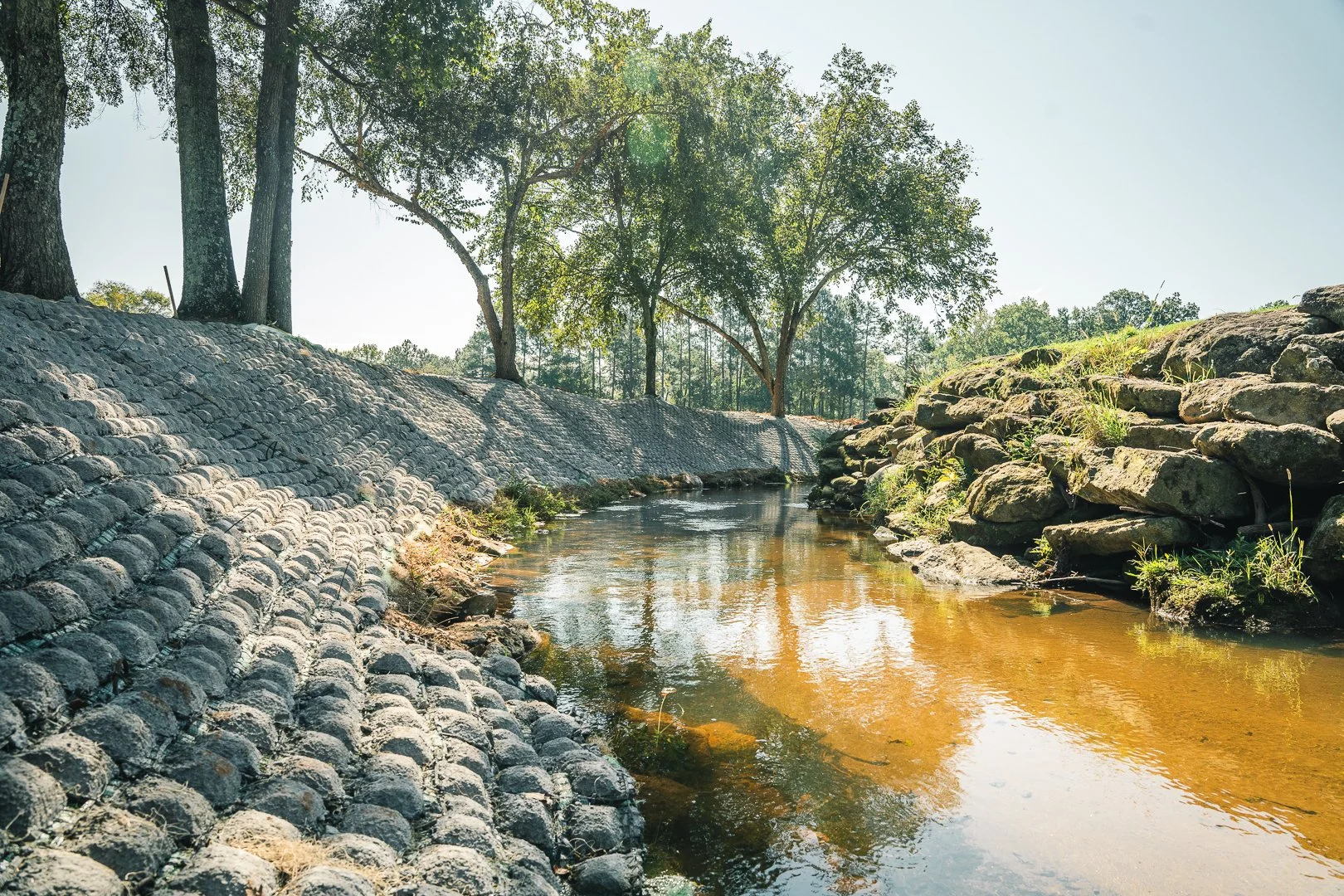
Stone, Underlayment, and Material Performance
Material selection is where many level spreaders quietly fail. Stone is often viewed as a static element, but in hydraulic applications it is dynamic. Its performance depends on size, gradation, placement, and interaction with underlying soils.
Stone that is too small can be displaced under peak flows. Stone that is poorly graded allows water to move through voids with enough force to mobilize underlying soils. In both cases, erosion begins beneath the visible surface, making early detection difficult.
Properly graded stone distributes forces across multiple contact points, reducing movement and maintaining structural integrity. Keying stone into the slope prevents downslope migration and preserves the elevation of the lip. These details are frequently omitted in field installations, often due to time or budget constraints.
Underlayment is equally critical. Nonwoven geotextile serves as a separation layer, preventing fine soils from migrating into the stone matrix. Without it, subsurface erosion undermines the structure even if surface conditions appear stable. In many retrofit evaluations, the absence of geotextile is the root cause of recurring failures.
Material performance must also be evaluated in the context of maintenance. Stone systems that require frequent regrading or replacement introduce long-term costs that often exceed the initial savings of cheaper materials. Designing for durability reduces lifecycle costs and improves reliability.
Downstream Stabilization and Receiving Area Design
A level spreader does not end at the lip. The receiving area is an integral part of the system. Its ability to accept sheet flow without erosion determines whether the spreader achieves its purpose.
Vegetation is the most common stabilization method, but it must be appropriate to the site. Dense root systems provide soil reinforcement, but woody species can disrupt flow patterns and create maintenance challenges. Turf grasses may be suitable in some contexts but insufficient on steeper slopes or in shaded areas.
Rolled erosion control products, soil reinforcement mats, and native plantings are often required to establish stable conditions, particularly in high-risk areas. The selection of stabilization measures should consider slope, soil type, sunlight, and maintenance access.
Compacted soils are a frequent hidden issue. Even with vegetation, compacted soils limit infiltration and increase runoff velocities. In these cases, soil amendment or decompaction may be necessary to restore function.
Designing the receiving area as a system component rather than an afterthought is essential. Failure to do so shifts erosion rather than eliminating it.
Inspection, Maintenance, and Long-Term Reliability
Level spreaders are often perceived as low-maintenance features, but this perception leads directly to failure. While they do not require frequent intervention, they do require periodic inspection to ensure that subtle changes do not compromise performance.
Key inspection points include sediment accumulation along the lip, stone displacement, vegetation changes, and signs of reconcentration downstream. Inspections are most valuable after significant storm events, when weaknesses are most likely to be revealed.
Maintenance does not need to be intensive to be effective. Removing sediment, trimming encroaching vegetation, and addressing minor elevation changes early prevents major repairs later. Establishing clear responsibility for inspections is often the missing link in long-term performance.

From a compliance standpoint, documented inspections and maintenance activities also provide valuable records. These records demonstrate proactive management and can reduce regulatory risk if issues arise.
How Ecological Improvements Approaches Level Spreader Failures
When Ecological Improvements evaluates a failing level spreader, the process begins with a site-specific assessment rather than an assumption. Elevations are verified. Soils are evaluated. Upstream BMP performance is reviewed. Downstream conditions are inspected.
Rebuilding is approached with intent. The level lip is re-established with verified control. Appropriate geotextile is installed. Stone is selected and placed based on hydraulic requirements. The receiving area is stabilized using methods suited to the site. A basic inspection plan is defined so performance can be maintained.
This approach reflects a broader philosophy: erosion control is not about applying treatments. It is about restoring function within a system.
When Level Spreaders Are the Right Solution and When They Are Not
Level spreaders are highly effective when used within their design limits. They are well-suited for moderate drainage areas, gentle slopes, and sites where sheet flow can be safely dispersed.
They are not appropriate where contributing drainage areas are excessive, slopes are too steep, or downstream stabilization is not feasible. In these cases, alternative energy dissipation or conveyance strategies may be required.
Recognizing these limits is part of responsible design. Misapplication leads to predictable failure and unnecessary cost.
Conclusion and Professional Guidance
When designed, built, and maintained correctly, level spreaders are one of the most elegant stormwater tools available. They function quietly, protect sensitive areas, and reduce downstream impacts without mechanical complexity.
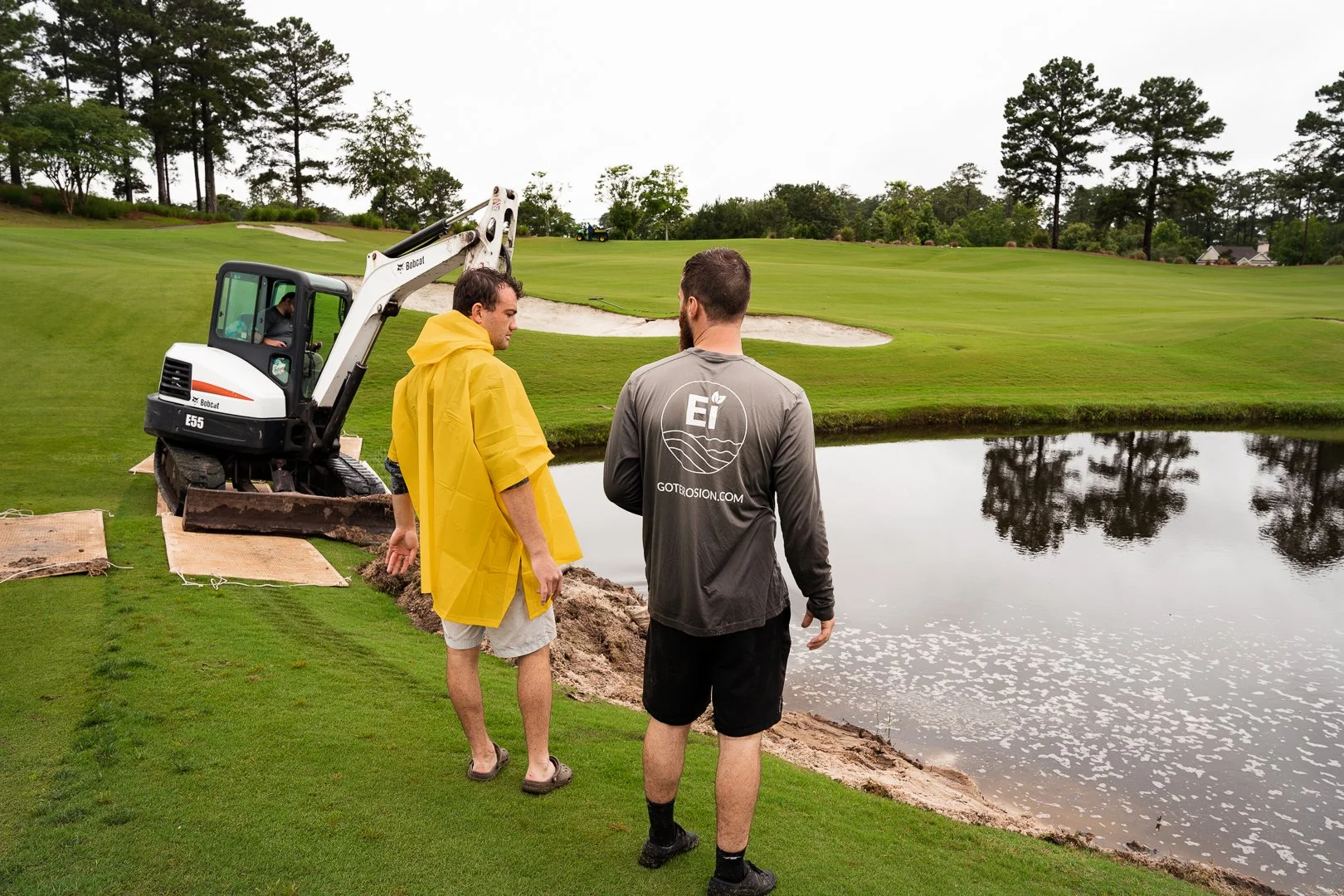
When shortcuts are taken, they become chronic problem areas that undermine the entire stormwater system.
Ecological Improvements approaches level spreaders as engineered components within a larger system. This perspective is what allows failures to be diagnosed accurately and rebuilt for long-term performance rather than temporary relief.
Schedule a Site Evaluation
If you are experiencing erosion below an outfall, repeated stone displacement, or regulatory concerns tied to a level spreader, a site evaluation can identify the root cause and appropriate corrective action.
A structured assessment provides clarity, reduces guesswork, and supports informed decision-making.